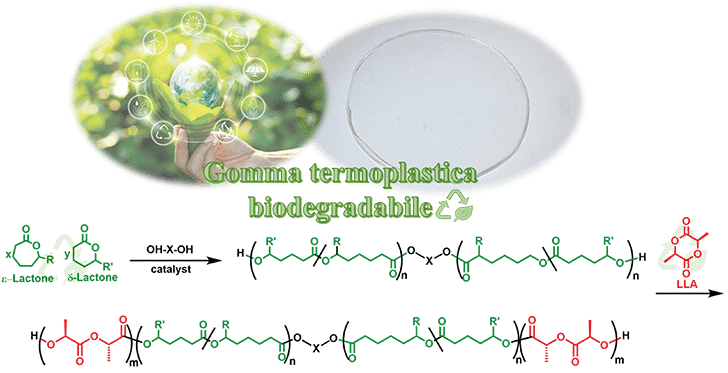
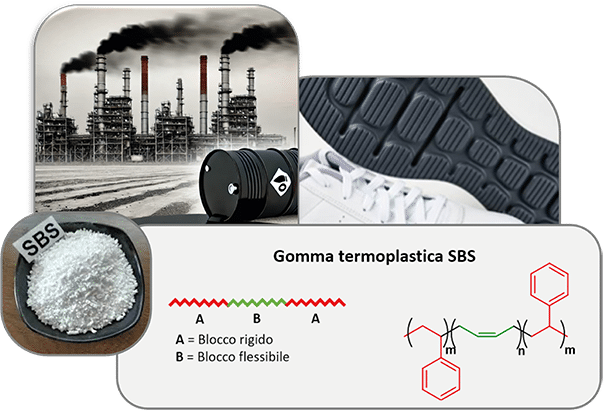
OBJECTIVES AND EXPECTED RESULTSThe main objective is to develop ABA triblock thermoplastic elastomers composed of bio-based, biodegradable aliphatic polyesters, ideal for a sustainable polymer industry. These materials are:
- Renewable
- Biodegradable
- Mechanically or chemically recyclable
A key polymer in this class is PLA (Poly(lactic acid)), currently produced at over 400,000 tons/year via ROP of lactide, a dimer from biomass fermentation. PLA is a semi-crystalline polymer with a melting temperature (Tm) of ~170 °C and a glass transition temperature (Tg) of ~65 °C, showing properties comparable to polystyrene.
In the ABA structure:
- PLA is used for the rigid A blocks
- The flexible B block is based on δ-lactones, naturally occurring cyclic esters obtained from biomass, already used as flavoring agents or fragrances in the food and cosmetic industries.
Specifically, polymers from δ-hexalactone and its copolymers with ξ-caprolactone have already been prepared. Poly(δ-hexalactone) has a Tg < –60 °C and can be quantitatively depolymerized under mild conditions, making it particularly suitable for circular production processes.