
On 1 July 2026, in the Aula Scipione Bobbio at the University of Naples Federico II, REMICS – Ricerca da Ecosister e MICS per l’Innovazione Circolare e Sostenibile (Research from Ecosister and MICS for Circular and Sustainable Innovation) officially got under way. The programme is the result of a collaboration between MICS Foundation, successor to the Made in Italy Circolare e Sostenibile Extended Partnership, and Ecosister, Emilia-Romagna’s innovation network. Funded by Italy’s National Operational Programme (PON) as a continuation of the PNRR (Italy’s National Recovery and Resilience Plan), the project brings together 27 universities, research bodies and companies. Its aim is to take the research lines launched during the PNRR phase to market and to accelerate the shift of Italian manufacturing towards the principles of Industry 5.0 and the circular economy.
This article covers everything you need to know about REMICS and Polo MICS: how the project is structured, the technologies involved, the role of SMEs in Southern Italy and the partners taking part.
What REMICS is and where it comes from
REMICS is an industrial research programme that builds on the work of the Made in Italy Circolare e Sostenibile Extended Partnership during its PNRR-funded phase. With the move to the National Operational Programme, the objective changes in nature: no longer just generating knowledge, but bringing it to a level of maturity at which real businesses can adopt it.
As Roberto Merlo, Director General of MICS Foundation, points out, the project sits “within the values of Industry 5.0, which goes beyond automation alone to put workers, sustainability and the resilience of production systems at the centre”. Merlo notes that Italy is Europe’s leading manufacturing country by number of SMEs, and that the primary goal of REMICS is “to build on what was achieved in that period, bringing to market the projects most ready to make the leap”.
Marco Degani, Executive Director of Ecosister, shares this view: the project continues a journey already under way, contributing “the most mature research lines” from Emilia-Romagna’s research and innovation network, with the aim of turning them into concrete, lasting innovation for industry and the regions.
The project’s two lines: REMICS and Polo MICS
The programme is structured around two complementary lines of action, each with its own objective.
Line 1.1.2 – REMICS: from research to industrial validation
The REMICS Line is dedicated to research and experimental development to raise the technology readiness level (TRL) of three key areas identified during the PNRR phase:
- Collaborative robotics and industrial exoskeletons, providing physical support and improving operator safety on production lines.
- Human digital twins: digital systems that monitor workers in production environments, helping to prevent risks and optimise workloads.
- Bio-based and smart materials for fashion and furniture, two sectors at the heart of Made in Italy, where replacing traditional materials with sustainable alternatives has a direct impact on competitiveness.
The stated objective is precise and measurable: to take these technologies from the laboratory, where they currently stand at TRL 3-4, to validation in real operating environments at TRL 7-8, within 18 months.
Line 1.1.3b – Polo MICS: technology transfer for SMEs in Southern Italy
While REMICS focuses on technology, the Polo MICS Line focuses on the regions. The innovation hub is coordinated by HUB MICS Sud, MICS Foundation’s Southern Italy office, together with UNINA-CeSMA, the Centre for Advanced Metrology and Technology Services at the University of Naples Federico II.
Polo MICS offers manufacturing SMEs in Southern Italy three types of service:
- Technology scouting, to identify the solutions best suited to each company’s specific needs.
- Advanced training, to build the skills needed to adopt new technologies.
- Innovation vouchers and matchmaking with the research community, to break down the financial and relational barriers that often hold back innovation in small and medium-sized enterprises.
Antonio Lanzotti, Full Professor of Design and Methods in Industrial Engineering at the University of Naples Federico II and MICS Delegate for Southern Italy, explains: “The post-PNRR era has begun and the challenge is getting harder: developing innovative products and materials with businesses in Southern Italy. Long-standing and new partners joining forces to succeed for Italy: united for Made in Italy.”
The project’s 27 partners
REMICS and Polo MICS involve a broad partnership of companies, research centres and universities from across Italy: 3DNA, Beyondshape, Comau, the National Research Council (CNR), ETA Bioengineering, Herobots, the Italian National Institute of Health (ISS), Nexus, Politecnico di Bari, Politecnico di Milano, Politecnico di Torino, Sophia High Tech, the University of Bergamo, the University of Bologna (Alma Mater Studiorum), the University of Brescia, the University of Florence, the University of Naples Federico II, the University of Padua, the University of Palermo, the University of Salerno, Vaia and Vesevo.
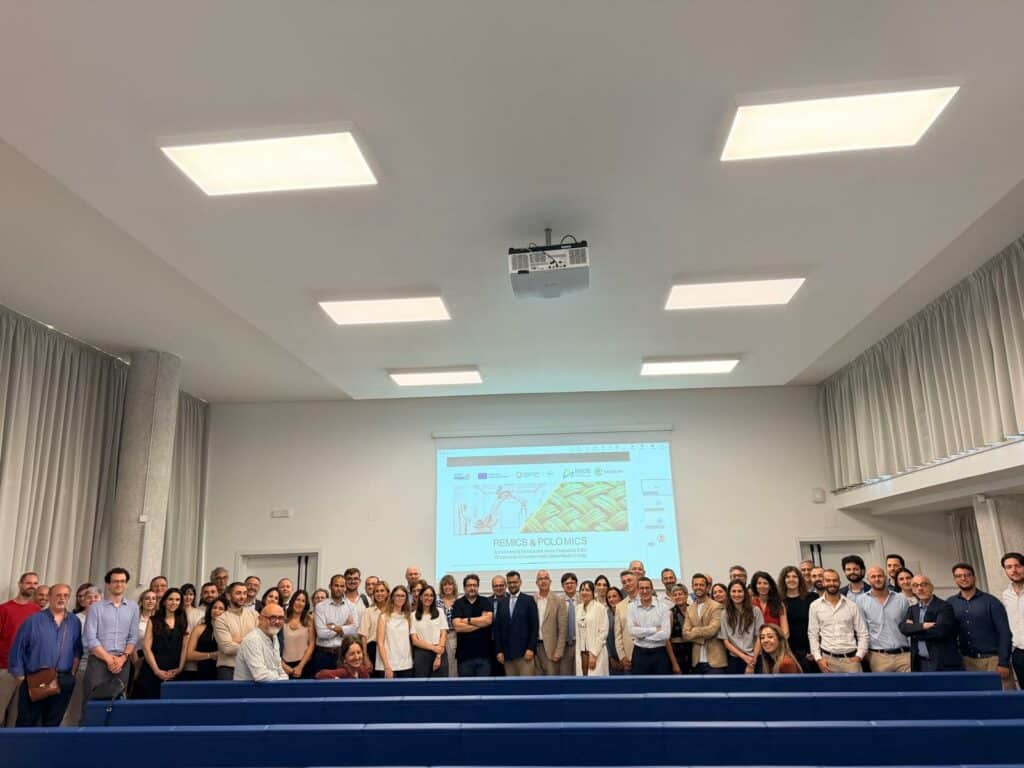
The project consortium met for the first time on 1 July 2026 at Federico II University in Naples, in the presence of the Rector, Professor Matteo Lorito, to set up its governance bodies and agree the operational roadmap for the next 18 months.
Why REMICS matters for Italian manufacturing
REMICS is not a stand-alone project: it marks the shift from the exploratory PNRR phase to the industrialisation of research results. The three technologies at its core – collaborative robotics, human digital twins and bio-based materials – address three distinct yet complementary competitive levers for Italian manufacturing: worker safety and wellbeing, material sustainability and process productivity.
REMICS is an industrial research programme funded by the National Operational Programme (PON). Born from a collaboration between MICS Foundation and Ecosister, it brings together 27 organisations to develop and validate technologies for sustainable manufacturing.
The REMICS line follows an 18-month pathway to take technologies from TRL 3-4 to TRL 7-8 in an operating environment. The project as a whole runs from July 2026 to December 2027.