
Knowledge that drives innovation
Servitization 2035: data, sustainability and new industrial models for Europe
Industrial servitization is the shift by which manufacturing companies move from a logic centred on selling products to one oriented towards providing integrated product–service solutions.
In this context, servitization can be understood as a transformation of business models in which products, services and digital components are combined to deliver value and performance over time.
Connected products generate large volumes of data (for example operational telemetry, operating logs, environmental sensors and usage data) which, once properly collected, qualified and governed, become the raw material for advanced services: digital twins, remote diagnostics and repair, active predictive maintenance, dynamic consumption optimisation, offer personalisation and usage-based pricing.
Innovative procurement models for the circular supply chain: the new frontier for relaunching the competitiveness of Made in Italy
Today’s industrial landscape is shaped by deep, structural uncertainty. Companies face daily supply-chain disruptions driven by geopolitical shocks, trade tensions, climate and social pressures, market volatility and hyper-competition for critical raw materials (Massari et al. 2025). The fragmentation of trade, bottlenecks in the supply of critical materials and components, the race for Industry 4.0 and 5.0 technologies, tighter ESG regulation and rising expectations from institutional stakeholders, customers and consumers are permanently rewriting how firms manage supply chains. At the same time, growing consumption of raw materials and the production of waste and industrial emissions are undermining the sustainability of socio-economic systems.
Systemic Intelligence and Advanced Technologies for Circular Made in Italy Fashion
This White Paper sits in the reference area of fashion, textiles and advanced manufacturing systems, addressing the transition towards circular, digitalised and sustainable models across the full product life cycle. Its aim is to outline a short-, medium- and long-term strategic vision for research and innovation in fashion, in line with the trajectories of the Made in Italy Circolare e Sostenibile (MICS) Extended Partnership. The White Paper provides an integrated framework connecting design, production and end of life, highlighting the enabling role of advanced digital and manufacturing technologies in supporting data-driven decisions, circular business models and new forms of advanced manufacturing. In this perspective, the document seeks to guide both applied research and technology transfer towards scalable, measurable solutions aligned with sustainability goals.
Made in Italy as an open project. Design, sustainability and platforms for cultural and productive innovation.
Made in Italy is undergoing a profound transformation, driven by economic, environmental, technological and cultural change that challenges traditional definitions. In a context of growing complexity and instability, the value of Made in Italy can no longer be reduced solely to geographic origin, formal product quality or brand symbolism.
A rethink is needed that preserves its historical identity while opening it to new forms of meaning, responsibility and value creation. In this perspective, Made in Italy evolves from a mark of origin into a systemic practice — an articulated set of cultural,
productive and relational processes.
The future of Made in Italy: strategies for reconfiguring value chains
Over recent decades, global value chains have become increasingly fragmented and internationalised, allowing multinational companies to cut costs, access specialist skills and serve global markets (Furr et al., 2022; Kano et al., 2020).
This model, strongly oriented towards efficiency and geographic specialisation, has however shown structural limits in light of the shocks of the past five years — from the pandemic to the war in
Ukraine, and from the energy crisis to tariffs — which have slowed and disrupted global supply chains and exposed their vulnerabilities and fragility (Gereffi, 2020; Witt et al., 2023).
Beyond these shocks, rising geopolitical tensions (especially between the United States and China), opportunities from the rapid spread of new digital technologies (including artificial intelligence) and the need to increase the sustainability — environmental and social — of activities are deeply reshaping how companies define the geography of sourcing, production and value creation.
Transitional Industrial Designer
This contribution summarises research carried out in Spoke 1 “Advanced digital design: technologies, processes and tools” of the MICS Extended Partnership
funded under the PNRR. The ten projects developed by this multidisciplinary research group have tested new knowledge-exchange processes that have generated multiple Proofs of Concept for innovative product–service solutions.
FuturArredo
The furniture industry is the second-largest market in the European economy and is of strategic importance for Europe and for Italy (JRC,
2023). Around a quarter of the world’s furniture is produced in Europe, with an estimated value of about €262 billion in 2025 and projected growth over the next five years (JRC, 2023; Mordor
Intelligence, 2025). This development is supported by a wave of renovations — linked both to tourism and to increasingly connected, technology-rich infrastructure and products — and by constant shifts in fashion and trends. At the same time, this growth brings challenges that define our era and reflect deeper social change, with a direct impact on the furniture sector.
Design-driven strategies for a sustainable Made in Italy
In the context of today’s ecological, digital and social transitions, design emerges as a strategic lever for steering innovation towards more sustainable and responsible development models. This centrality is also confirmed at regulatory level by the recent European Regulation establishing a framework for ecodesign requirements for sustainable products (Reg. EU 2024/1781), which recognises the design phase as decisive in reducing environmental impacts across the full product life cycle and therefore calls for a systemic, futures-oriented approach.
Against this backdrop, the White Paper aims to outline a strategic vision for design for sustainability, aligned with the trajectories identified by MICS and with ongoing innovation processes.
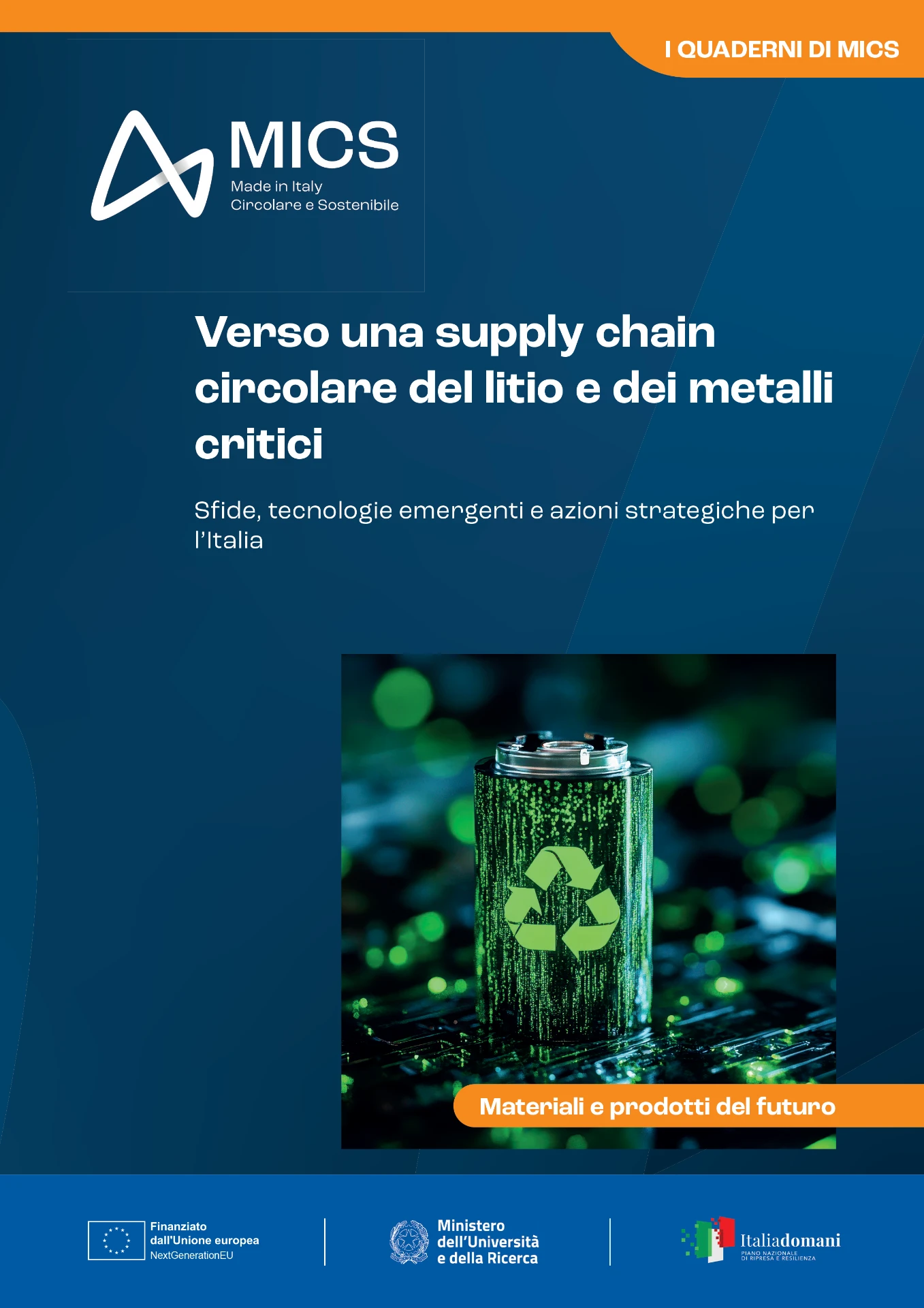
Towards a circular supply chain for lithium and critical metals
The energy and digital transition underway has made critical raw materials (CRM) central to industrial competitiveness, economic security and technological sovereignty. In particular, lithium-ion batteries (Lithium-Ion Batteries,
LIBs) are an enabling technology for electric mobility, stationary energy storage and numerous industrial and digital applications.
Their large-scale rollout has, however, increased dependence on a limited set of raw materials — including lithium, nickel, cobalt, manganese and graphite —
characterised by high geographic concentration of extraction and refining, market volatility and growing geopolitical risk.
Rediscovering the value of people in the future of manufacturing
Advanced manufacturing is a complex socio-technical system in which technology, organisation and the human factor co-evolve. At a time when technological change has accelerated sharply in recent years, a reflection on the role of people in this context is therefore essential.
Over the next 5–10 years, research and innovation in the Italian manufacturing system will be called on to meet a dual challenge: on the one hand, sustaining the competitiveness and resilience of Made in Italy value chains in an increasingly unstable and technologically advanced global context; on the other, ensuring that digital and industrial transformation unfolds in a sustainable, inclusive and human-centred way.
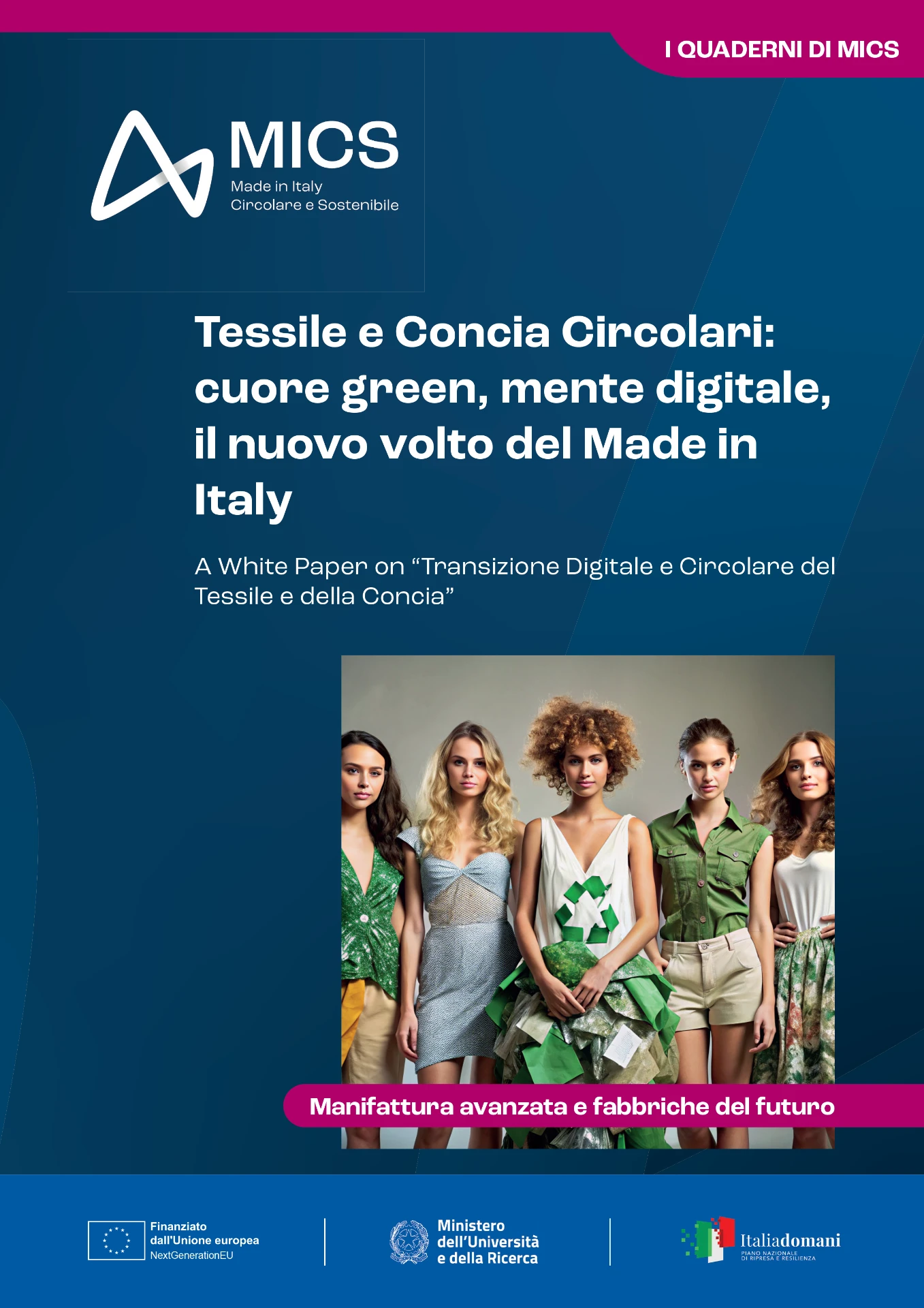
Circular Textiles and Tanning: a green heart, a digital mind – the new face of Made in Italy
The textile and tanning supply chain is one of the identity, cultural and industrial pillars of Made in Italy. Today, however, it sits at the centre of a deep transformation driven by environmental pressures, evolving European regulation, new consumer expectations and technological acceleration. The rise in post-consumer textile waste (estimated in millions of tonnes per year at European level) and significant volumes of tanning waste pose a structural challenge to the sector’s sustainability.
At the same time, the introduction of Extended Producer Responsibility (EPR), European circular-economy strategies and climate-neutrality targets make an urgent rethink of production models necessary across the full product life cycle: design, production, use, end of life and reintroduction into material cycles.
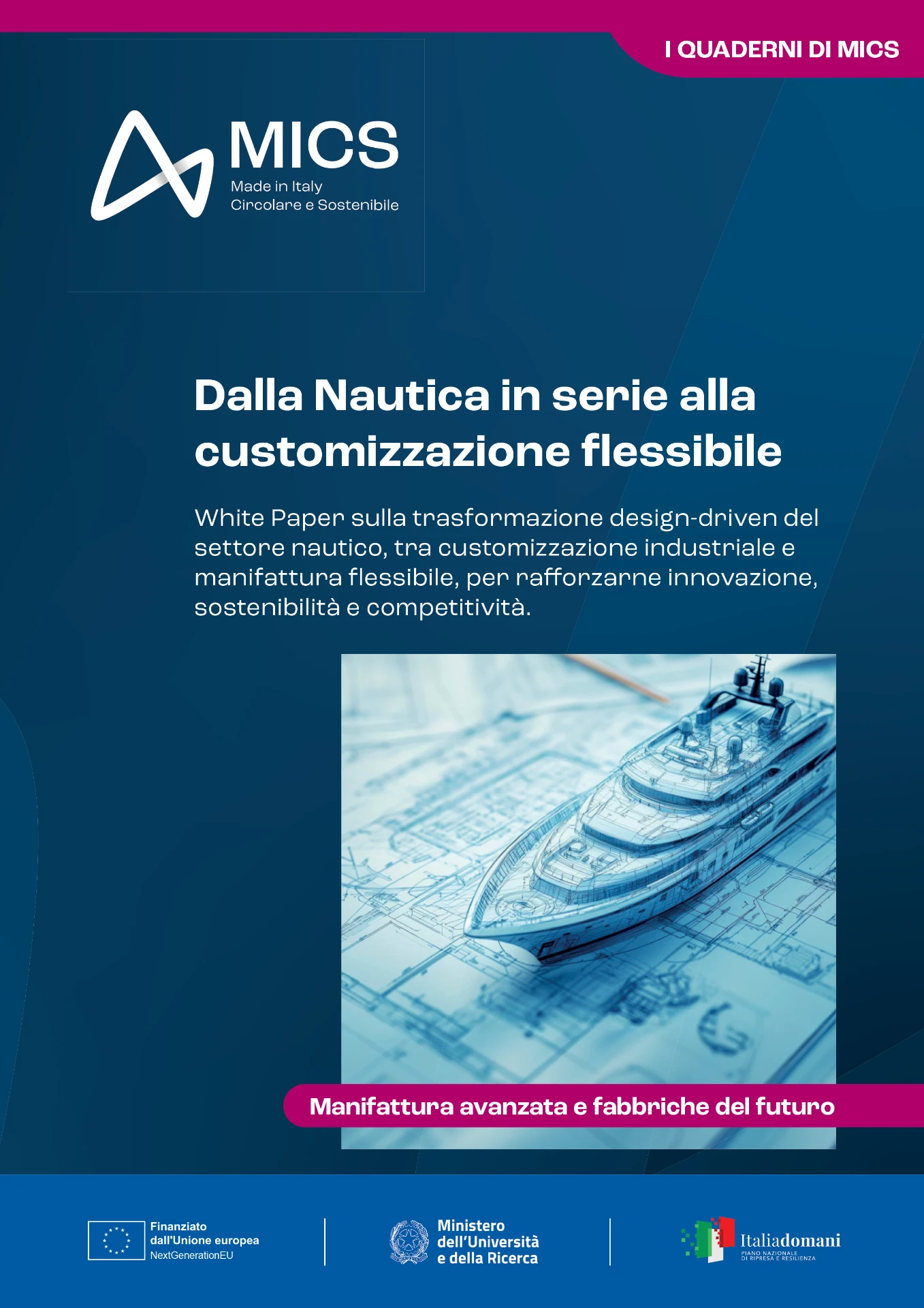
From Series Production to Flexible Customisation in the Nautical Sector
Industrial production systems are undergoing a structural transformation that challenges the premises of the twentieth-century model based on standardisation and economies of scale.
Growing demand fragmentation, accelerating innovation, regulatory pressure linked to the ecological transition and the centrality of the user experience are progressively eroding the validity of the “one-size-fits-all” paradigm
At the same time, value has increasingly shifted from function to experience and meaning (Pine & Gilmore, 1999; Holbrook, 2006). In the nautical sector this shift is especially clear: the vessel is no longer merely a status good, but a system of values and an experiential platform in which identity, sustainability and design quality play a central role (Ansaloni et al., 2024).